The most complete history of Dublin on the Web.
Extensive history of Dublin site, with on-line books and pictures.
About this chapter
Extensive history of Dublin site, with on-line books and pictures.
Word count
2,800 words
History By Area
Search the list of areas to find what you’re looking for.
 Text Search
Search the entire site for matching words.
Let Me Know
Your opinions, questions, requests, my E-mail address, etc
.
My First Book.
Text Search
Search the entire site for matching words.
Let Me Know
Your opinions, questions, requests, my E-mail address, etc
.
My First Book.
 Along the coast from Booterstown to Killiney
Chronology of Dublin.
A Timeline of Dublin history.
History and Antiquities of Dublin.
The first major history of the city. (1766)
Neighbourhood of Dublin.
Classic volume covering the outer suburbs in 43 chapters (Third and enlarged edition, 1920).
A History of the County Dublin.
The ultimate reference book on suburban Dublin in six volumes. (pub. 1902-1920)
Dublin Street Names: Dated and Explained
By C. T. M’Cready (1892)
Dublin: A Historical and Topographical Account.
Central Dublin in detail. (pub. 1907)
History of the Dublin Catholic Cemeteries.
Where the bodies are buried! (pub. 1900)
James Joyce - his life and works.
Bob Williams chronicles the life and works of Joyce.
Along the coast from Booterstown to Killiney
Chronology of Dublin.
A Timeline of Dublin history.
History and Antiquities of Dublin.
The first major history of the city. (1766)
Neighbourhood of Dublin.
Classic volume covering the outer suburbs in 43 chapters (Third and enlarged edition, 1920).
A History of the County Dublin.
The ultimate reference book on suburban Dublin in six volumes. (pub. 1902-1920)
Dublin Street Names: Dated and Explained
By C. T. M’Cready (1892)
Dublin: A Historical and Topographical Account.
Central Dublin in detail. (pub. 1907)
History of the Dublin Catholic Cemeteries.
Where the bodies are buried! (pub. 1900)
James Joyce - his life and works.
Bob Williams chronicles the life and works of Joyce.
 The Story of Dublin
Fine introduction to the centre of Dublin by D. A. Chart. (pub. 1907)
North Dublin
The north city and suburbs by Dillon Cosgrove. (pub. 1909)
D’Alton’s Dublin
City and County, north and south (1838)
Memorable Dublin Houses
Where the rich and famous lived in old Dublin. By Wilmot Harrison. (pub. 1890)
The History of Tallaght
By William Domville Handcock M.A. (1899)
Recollections of Lord Cloncurry
Ireland before and after the Union.
Buck Whaley’s Memoirs.
Buck’s account of his life, gambling losses and travels (1797). First published in 1906
Lives of the Lord Chancellors. Vol. I.
Personal Sketches by Sir Jonah Barrington.
The old rogue, in exile in France, looks back on a busy life. (1827)
Life In Old Dublin
Quirky account by James Collins of life in the Cook Street area. (1913)
An Historical Guide to Dublin
A detailed guide for tourists. Published in 1825.
Ireland 60 Years Ago.
Ireland and Dublin at the end of the 18th century. It’s great fun.
Picturesque Dublin Old and New
A heady mix of history and gossip by Frances Gerard. (pub. 1898)
Letters and Leaders of My Day.
From Parnell to Independence. Tim Healy tells it like he thinks he saw it!
The Hill of Howth Trams
Jim Kilroy’s stories and illustrations.
The Story of Dublin
Fine introduction to the centre of Dublin by D. A. Chart. (pub. 1907)
North Dublin
The north city and suburbs by Dillon Cosgrove. (pub. 1909)
D’Alton’s Dublin
City and County, north and south (1838)
Memorable Dublin Houses
Where the rich and famous lived in old Dublin. By Wilmot Harrison. (pub. 1890)
The History of Tallaght
By William Domville Handcock M.A. (1899)
Recollections of Lord Cloncurry
Ireland before and after the Union.
Buck Whaley’s Memoirs.
Buck’s account of his life, gambling losses and travels (1797). First published in 1906
Lives of the Lord Chancellors. Vol. I.
Personal Sketches by Sir Jonah Barrington.
The old rogue, in exile in France, looks back on a busy life. (1827)
Life In Old Dublin
Quirky account by James Collins of life in the Cook Street area. (1913)
An Historical Guide to Dublin
A detailed guide for tourists. Published in 1825.
Ireland 60 Years Ago.
Ireland and Dublin at the end of the 18th century. It’s great fun.
Picturesque Dublin Old and New
A heady mix of history and gossip by Frances Gerard. (pub. 1898)
Letters and Leaders of My Day.
From Parnell to Independence. Tim Healy tells it like he thinks he saw it!
The Hill of Howth Trams
Jim Kilroy’s stories and illustrations.
 Sir Charles Cameron Remembers
Anecdotes and memories of a Freeman of Dublin. (1913)
The Sham Squire and the Informers of 1798
Lord Edward’s Revolt, patriots and traitors.
A History of the City of Dublin
J. T. Gilbert’s ground-breaking work. Vol. 1 (1854).
Mecredy’s Guide to the City. (1905)
A guide for tourists which is still useful today. Large file.
1916 and all that.
A collection of articles about the Easter Rising.
Dublin: Sketch Development Plan.
Published by the Corporation in 1941 this gives an idea of how the city could have developed.
Sir Charles Cameron Remembers
Anecdotes and memories of a Freeman of Dublin. (1913)
The Sham Squire and the Informers of 1798
Lord Edward’s Revolt, patriots and traitors.
A History of the City of Dublin
J. T. Gilbert’s ground-breaking work. Vol. 1 (1854).
Mecredy’s Guide to the City. (1905)
A guide for tourists which is still useful today. Large file.
1916 and all that.
A collection of articles about the Easter Rising.
Dublin: Sketch Development Plan.
Published by the Corporation in 1941 this gives an idea of how the city could have developed.
 Illustrations
Photographs of old Dublin..
The Irish Sketch Book (1842)
William Makepeace Thackeray details his Irish visit.
Irish Varieties (1878)
A selection of pieces about Dalkey, Bulloch and Kingstown.
Lucania
The Rev. Donegan on Lucan (1902).
Walking Ireland
A Frenchman’s Walks Through Ireland. (1796/7)
English As We Speak It In Ireland
By P. W. Joyce.
Seventy Years of Irish Life
W. R. le Fanu recalls Ireland in the past. (pub. 1893)
Short Histories of Dublin Parishes
A selection of parishes by the Most Rev. M. Donnelly, D.D..
Annals of the Irish Parliaments. (1895)
Odd little volume concerning Ireland’s Parliaments up to 1800..
Recollections of Dublin Castle & Society.
Anonymous volume from 1902.
Maps of Dublin
Links to maps of the city and county.
General Articles
Some smaller articles from, and about, days gone by
Background
Information on the site.
Links
Other historic sites to visit.
FAQ
Answers to some questions.
Last updated:
02 January 2004
Illustrations
Photographs of old Dublin..
The Irish Sketch Book (1842)
William Makepeace Thackeray details his Irish visit.
Irish Varieties (1878)
A selection of pieces about Dalkey, Bulloch and Kingstown.
Lucania
The Rev. Donegan on Lucan (1902).
Walking Ireland
A Frenchman’s Walks Through Ireland. (1796/7)
English As We Speak It In Ireland
By P. W. Joyce.
Seventy Years of Irish Life
W. R. le Fanu recalls Ireland in the past. (pub. 1893)
Short Histories of Dublin Parishes
A selection of parishes by the Most Rev. M. Donnelly, D.D..
Annals of the Irish Parliaments. (1895)
Odd little volume concerning Ireland’s Parliaments up to 1800..
Recollections of Dublin Castle & Society.
Anonymous volume from 1902.
Maps of Dublin
Links to maps of the city and county.
General Articles
Some smaller articles from, and about, days gone by
Background
Information on the site.
Links
Other historic sites to visit.
FAQ
Answers to some questions.
Last updated:
02 January 2004


 It’s been a few weeks since I updated - computer problems, damaged shoulder (too much computer work!), etc. Here’s a selection of bits and pieces I’ve never quite gotten around to putting up. Have fun and Happy New Year!
Excerpts from The Irish Soldier, November 1st, 1918. (Thanks to Patrick Lynch for the documents)
Two Irish Airmen
 Even in the annals of the Royal Air Force, which abound in instances of extraordinarily young men who have performed miracles of valour and of skill during the war, the name of COWAN shines with a conspicuous lustre. Two young Irishmen, Philip Charles Cowan, and his younger brother, Sidney Edward Cowan, were among the first to uphold the chivalrous traditions of Irish gallantry in the air service. Both have since been reported missing and officially presumed to have been killed; both had obtained their captaincies, before they met their deaths, at the ages of twenty-two and nineteen. They belonged to a family in which public service is a proud tradition, being sons of Mr. P. C, Cowan, of Dublin, the Chief Engineering Inspector of the Irish Local Government Board. The elder brother obtained his commission in the Manchester Regiment in the first month of the war, and did not join the Flying Corps till October, 1916; he was reported missing on November 8th of the following year. Writing of him at the time of his death, when the first promise of his career as an airman was only beginning to reveal itself, a General in the Flying Corps in France wrote to Headquarters: “He was a capital fellow, and a coming star turn. His younger brother last year was marvellous, and this one would have been the same,” Almost exactly a year earlier, the younger brother, Captain Sidney Cowan, M.C., had met with a similar fate. He had not been able to obtain his commission until August, 1915, on the day that he completed his eighteenth year; and though still a boy when he was killed, he had in fifteen months of service with the Royal Flying Corps attained a supreme position among his colleagues all over France. On May 31st, 1916, he won the Military Cross for the first time; the second award followed in October, and the third in November.
What’s in a name. This one has been around for a long time but I’ve done some interfering. Work out the clue and find the Dublin area - a basic knowledge of Irish may be required. You’ll need to print it out or just write the answers on a sheet of paper, Click Here or at the bottom for the answers
CHURCH REPTILE
CHAPELIZOD
SEA CREATURE STOREHOUSE
VERY DARK BOULDER
NEARLY A SHEEP
A GRAVELLY PASTE
FAG AN BEALACH
GET RID OF THIS WOMAN
SINGLE MEN DON’T RUN
BIG CAT’S PLACE
PROFESSOR, GIVE OVER
MR. SECOMBE IS ANGRY
HEAT’S OFF THE EXPLOSIVE DEVICE
NEARLY FALLING APART
HONEST OPINION
DUELLING WEAPON
STORMY RETREAT
BEAST IN STONE
DISPARAGE THE JUNGLE KING
ASSASSINATE THE ACTOR
A RODENT BEFORE THE PITS
A FISHY DRINKING VESSEL
AN ELUSIVE PEER
MOTIONLESS MUSICAL INSTRUMENT
TAXI LINGERIE
VERY FRAGILE IMPLEMENT
Snow Trouble At All …
It’s been a long time since Dublin had any snow worth mentioning (1982 springs to mind but I’ve never been great on dates … we must have had 2, maybe 3 inches. OK, if you’re digging yourself out of 10-foot snowdrifts on a regular basis it doesn’t sound like much, but it managed to bring Dublin to a halt for a couple of days).
Generally speaking Dublin has a pretty wet Winter … wet and cold … but snow is rare except on what we jokingly refer to as the Dublin Mountains = they get a light scattering (very picturesque!).
But tourists, damn their eyes, want snow scenes on their postcards and there are those unscrupulous enough to cater to their demented demands. After all, who in their right minds would want to see snow when they can experience a heavy rain shower?
With that in mind, here are two two postcards from 1907. Which came first? Spot the difference?
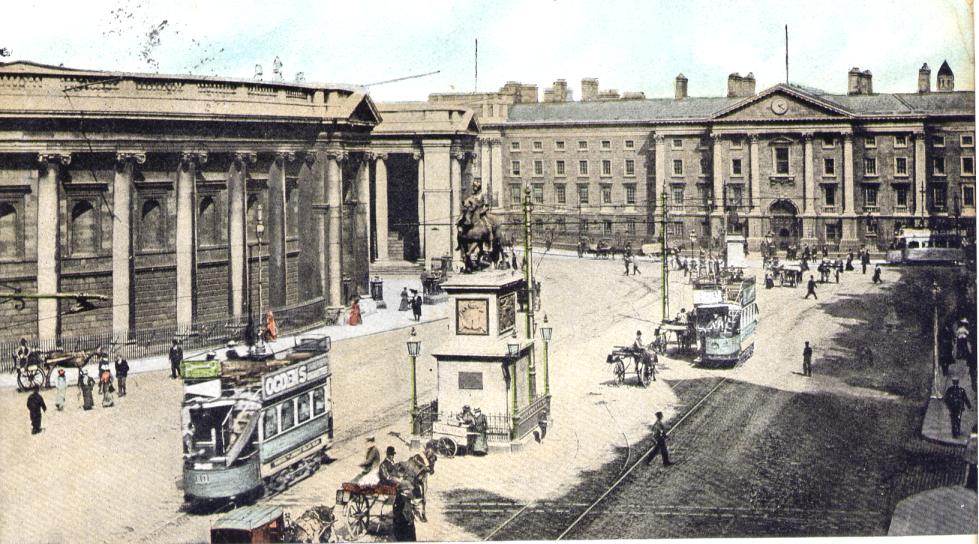
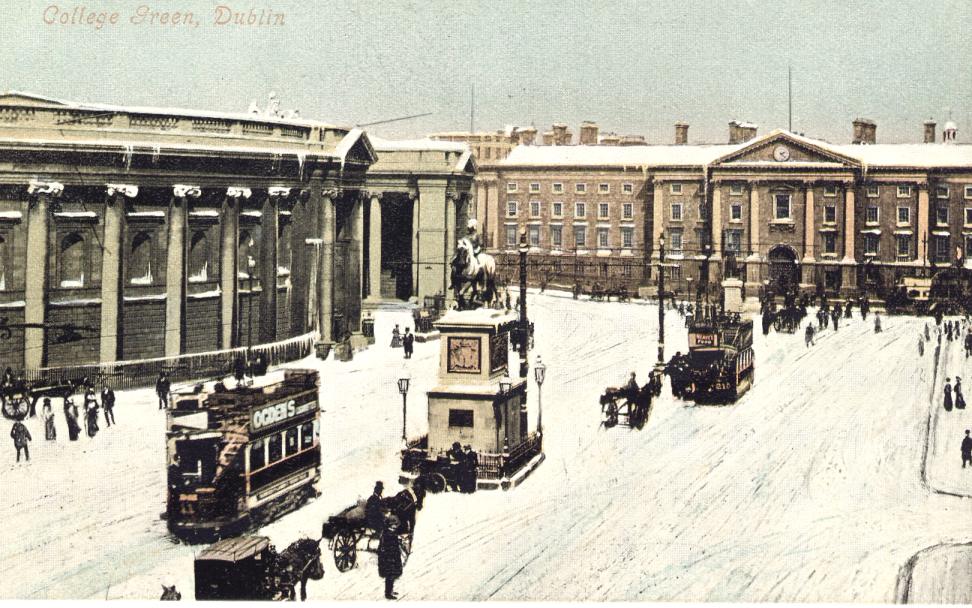
Of course, there were no computers back then, but the practice of colouring-in was common. While it does make the postcard look more appealing - at least initially - it usually serves only to blot out detail which is preserved on a black and white image.
More Lord Chancellors
Vol I (up to 1700ish) is complete and work is continuing on Vol. 2. (Chapters 36-48, to 1789ish). Click here or at the end of this piece to read them.
Life of Lord Chancellor Brodrick, Viscount Midleton, from his birth until the attempt to repeal the Test Act in 1717.
The family of Brodrick is of Norman descent, and settled in England during the days of William the Red-haired, Grants of land and high stations were theirs in successive reigns; and, when Charles I. was King, Sir Thomas Brodrick, Knight, had learned sons and accomplished daughters to extend the family name and renown. Alan, the eldest son, received Knighthood on the Restoration of King Charles II.; and, on March 19, 1660, was appointed one of the Commissioners for settling the affairs of Ireland. The favour of the King followed the family into Erin. But a short time elapsed before a Royal grant assigned ‘to Sir Alan Brodrick, his heirs and assigns, out of the forfeited lands, the full moiety in value, worth and purchase of 10,759 acres.’ The duties of putting the Acts of Settlement and Explanation in force required five Commissioners, one of whom was Sir Alan Brodrick. The brother of Sir Alan, St. John Brodrick, had taken an active part in the Civil Wars of Ireland, which commenced in 1641; and, sharing in the forfeited lands, got for his services, in November 1653, the lands of Ballyanin Garryduffe, East and West Ballyvodicke, West Ballintobride and Coolmore, in the barony of Barrymore, county Cork. In the first Parliament held in Ireland after the Restoration he represented the borough of Kinsale. He received the honour of Knighthood, and had the office of Provost Marshal-General of the Province of Munster, with a standing fee of 4s. 2½d. per diem, and a stipend for ten horsemen of 12d. sterling a-piece per diem, with all other fees. This appointment was conferred on him for life on May 2, 1661. He also had a special reservation made of his company of foot, as appears by the King’s letter - ‘By orders formerly given by George Duke of Albemarle, L.L., four companies were to be suspended, which the King had confirmed; but, upon the suit of St. John Brodrick, Esq., to be gratified with a command in Ireland, his Majesty for his many loyal services, was pleased to supersede his former resolutions so far as to appoint him to one of the said four companies.’ [Lodge’s Peerage of Ireland, vol. v. p. 162.] But the most important grants which this gentleman secured, were under the Act of Settlement; and by patent dated January 2, 1670, the castles, towns, and lands of Castleredmond, Corr Abbey, and divers other places in the Baronies of Barrymore, Fermoy, and Orrery, were erected into the manor of Midleton, with power to set apart 800 acres for demesne; to impark 800 more, with the privilege of courts, waifs, estrays, &c. Castleredmond and Corr Abbey being made a free borough and corporation, to extend every way from the middle of the town, 100 acres in the whole, to be named the borough and town of Midleton; to consist of a Sovereign, two bailiffs, and twelve burgesses, to be first named by him, with power to send two burgesses to Parliament; to have two maces borne before the Sovereign; he and his heirs to appoint a recorder, town-clerk, and other officers.
St. John Brodrick married Alice, daughter of Sir Randal Clayton, of Thelwall, in the county of Chester. The numerous progeny of six sons and six daughters sprung from the union. It is the career of Alan, the second son, I mean to trace. He rose by his great talents to the high rank of Lord Chancellor of Ireland.
Alan was born about the year 1660, and early displayed remarkable intelligence. It was this probably which led to his being destined for the bar; but whatever cause made him devote his future career to the profession of the law, it was destined to procure him a high position. During the struggles which followed the accession of James II. to the throne, Alan, then a practising barrister, cast his lot with his brother Protestants, and was quickly distinguished for promotion by the victorious William III. Perhaps being attainted, with his brother, by James II.’s Irish Parliament was not a bad recommendation to King William, for no sooner had he places to bestow than he very properly gave them to those who had suffered in his cause. On February 19th, 1690, his Majesty made Mr. Brodrick his Serjeant-at-Law; and, at the same time, by licence, allowed him to be of counsel to the Mayor of Cork. He had large and lucrative practice at the Irish bar, which led to his further promotion; and, on June 6th, 1695, he was appointed Solicitor-General for Ireland. The accession of Queen Anne, June 4, 1702, made no change in his position, for the Queen continued him in his office.
The Solicitor-General was returned to Parliament, in the year 1703, for the city of Cork, at the same time when his elder brother, Thomas, was returned, together with Sir John Percival, Baronet, for the county. The Duke of Ormond, then Viceroy, opened Parliament with the usual solemnities; and the Commons being called to attend the House of Lords on September 24, 1703, the Solicitor-General was chosen Speaker. He addressed the Lord-Lieutenant on that occasion, as follows:- ‘May it please your Excellency,
‘The Commons in Parliament assembled, have in obedience to your Grace’s command, proceeded to the choice of a Speaker, and their choice hath terminated in me. If steady loyalty to the Crown, sincere wishes, and a hearty inclination, with the utmost diligence to promote the prosperity of her Majesty and this kingdom were sufficient to qualify me for the due discharge of that great trust, I should not think it modest in me, but its opposite vice, to disable myself. For it is in the power, as it is the duty of every man, to be a loyal subject, and a lover of his country; and, I hope I may, without the least imputation of vanity, be permitted (upon this occasion) to affirm that I must forget my present sentiments, and be much altered from what I am, when I cease to be either.’ [Lodge’s Peerage of Ireland, vol. v. p. 164. This version is very different from the abstract contained in the Lords’ Journals of Ireland, vol. ii. p. 3, which is as follows:- ‘Alan Broderick, Esq., her Majesty’s Solicitor-General makes a speech, mentioning his being chosen by the Commons of Ireland as their Speaker, declaring his own unfitness for that trust and place, requests his Grace that he would be pleased to order the Commons to return to their House and choose a fitter person.’ This, I suspect, was a form usually spoken, and the text is the correct version.]
The Lord Chancellor, Sir Richard Cox, standing on the right’ hand of the Chair of State, thus addressed the Speaker:-
‘Mr. Solicitor, - The knowledge his Grace my Lord-Lieutenant has of you, and the character you have in the world, do fully satisfy his Grace that you are a person fitly qualified for the great trust reposed in you; and therefore his Grace hath readily approved of the choice which the Commons have made of you to be their Speaker.
‘It is a circumstance of great satisfaction to his Grace, that your election was unanimous; for his Grace cannot look upon this good agreement in the beginning, but as a certain presage of a happy conclusion of this Session of Parliament.’
Chancellor Index - See bottom of page for Vol. 2.